

close
Choose Your Site
Global
Social Media

Views: 0 Author: Site Editor Publish Time: 2026-09-05 Origin: Site


Diaphragm pumps use flexible membranes and check valves to provide reliable fluid transfer for general bulk applications. In contrast, valveless ceramic metering pumps utilize precision rotary and linear motion to eliminate check valves entirely. This comparison helps procurement managers and technical evaluators determine which pump technology fits their specific operational requirements, balancing the general utility of diaphragm systems against the high-accuracy, wear-resistant metering capabilities of valveless piston designs.
Key Takeaways:
Diaphragm pumps rely on inlet and outlet check valves, which can be susceptible to wear, sticking, and clogging in high-precision dosing scenarios.
Valveless piston designs eliminate check valves completely, utilizing synchronized mechanical motion to control fluid direction and displacement volume.
Advanced valveless systems achieve a repeat metering accuracy typically better than ±0.5% (tested with pure water).
High-purity ceramic materials in valveless pumps enable continuous, stable operation for over 60 million cycles without frequent maintenance interventions.
Selecting the correct fluid transfer technology requires matching mechanical capabilities to specific application demands. Diaphragm pumps and valveless piston pumps represent two distinct engineering approaches to moving liquids. While diaphragm pumps offer a proven, versatile method for general fluid transfer across various industrial sectors, valveless piston pumps provide specialized mechanical advantages for high-accuracy metering tasks. Evaluating these options requires a thorough analysis of their operating principles, maintenance profiles, and material durability to ensure the selected equipment aligns with lifecycle expectations and precision requirements.
Diaphragm pumps operate through the positive displacement of fluid using a flexible membrane. The core mechanism involves a diaphragm—typically manufactured from industrial rubber, thermoplastic, or Teflon—that flexes back and forth within an enclosed pumping chamber. As the mechanical or pneumatic drive pulls the diaphragm away from the chamber, it creates a localized vacuum that draws fluid into the pump. As the drive pushes the diaphragm back into the chamber, it pressurizes the fluid and forces it out into the discharge line.
To control the direction of fluid flow and prevent backflow during these pressure cycles, diaphragm pumps rely heavily on inlet and outlet check valves. These valves, often utilizing a ball-and-seat, flap, or duckbill mechanism, open and close in direct response to the pressure changes generated by the flexing membrane. When the diaphragm creates suction, the inlet valve is pulled open while the outlet valve is forced shut. During the discharge stroke, the internal pressure forces the inlet valve closed and pushes the outlet valve open, directing the fluid downstream.
This fundamental reliance on check valves dictates the operational profile and limitations of diaphragm pumps. While highly effective for moving a wide variety of fluids, including those with particulates or varying viscosities, the check valves introduce inherent mechanical vulnerabilities. Over time, the constant opening and closing can cause the valve seats to wear or degrade. Furthermore, if particulate matter prevents a valve ball from seating perfectly, fluid can slip backward during the pressure stroke. This slip directly impacts the pump's volumetric efficiency and consistency. Additionally, the reciprocating nature of the flexible membrane inherently creates a pulsating flow, which may require downstream pulsation dampeners in sensitive systems. Consequently, diaphragm pumps are highly effective for general fluid transfer but face mechanical limitations when applications demand continuous, ultra-precise micro-metering without volumetric drift.
Because diaphragm pumps rely on check valves that can wear or allow fluid slip, high-precision applications often require an alternative mechanical approach. Valveless piston pumps address this vulnerability by removing the check valves entirely. Instead of a flexing membrane and dynamic valves, these pumps utilize a rigid plunger that undergoes a synchronized rotary and linear motion within a precisely machined cylindrical sleeve.
During operation, the plunger rotates to align a specially designed flat cutout on its tip with the pump's inlet port, drawing fluid into the chamber as the plunger pulls back. As the plunger continues its rotation, the cutout aligns with the outlet port while the plunger simultaneously pushes forward, discharging the exact volume of fluid. This mechanical synchronization ensures that the inlet and outlet ports are never open to the pumping chamber at the same time. By mechanically controlling the flow path through geometric alignment rather than pressure-actuated valves, the valveless rotary design effectively replaces the function of check valves. The stroke length—which dictates the displacement volume per cycle—can typically be adjusted by altering the angle of the pump head relative to the drive mechanism, allowing for precise calibration of the injection volume.
The efficiency and accuracy of this valveless design depend entirely on the dimensional tolerance between the moving parts. For example, in Ceramic Valveless Metering Pump systems manufactured by H&R FLUID, the fit clearance between the high-precision valveless plunger pump and its sleeve is controlled around 2 microns. This microscopic clearance—a fraction of the width of a human hair—prevents internal fluid slip without requiring soft seals, elastomers, or O-rings in the wetted path. By eliminating both check valves and soft seals, the valveless mechanism provides a highly stable, repeatable displacement volume per stroke, isolating the fluid control process from the wear-and-tear issues typically associated with traditional valve-based positive displacement pumps.
Evaluating both systems against shared performance criteria reveals distinct operational profiles. Procurement managers and engineers must weigh initial utility against long-term maintenance costs and precision requirements. The following table compares the general mechanical characteristics of standard diaphragm pumps with the specific engineering metrics of H&R FLUID valveless ceramic metering pumps, providing a framework for technical evaluation.
Performance Dimension | Diaphragm Pumps (General Mechanics) | Valveless Ceramic Metering Pumps |
|---|---|---|
Flow Control Mechanism | Flexible membrane paired with inlet and outlet check valves. | Synchronized rotary and linear plunger motion; completely eliminates check valves. |
Metering Accuracy | Moderate; subject to variations from valve wear, sticking, or incomplete seating. | High; achieves a repeat metering accuracy typically better than ±0.5% (tested with pure water). |
Clearance & Sealing | Relies on soft, flexible diaphragms and dynamic valve seals to prevent backflow. | Relies on rigid, precision geometry; fit clearance between plunger and sleeve is controlled around 2 microns. |
Maintenance Profile | Requires periodic replacement of degraded diaphragms and worn check valves. | Low maintenance; features fewer moving parts and utilizes no soft seals in the primary fluid path. |
Wear Resistance | Dependent on the chemical and physical degradation rates of elastomers or thermoplastics. | Extremely high due to the advanced hardness and chemical inertness of ceramic materials. |
The comparison illustrates that while diaphragm pumps provide a versatile and robust solution for moving bulk fluids, their accuracy and maintenance intervals are inherently tied to the degradation of their flexible components and valves. Valveless piston pumps shift the reliability burden from flexible elastomers to rigid, high-precision geometry. This structural difference means valveless systems maintain their volumetric accuracy over a significantly longer operational period, provided the plunger and sleeve materials can withstand the friction of continuous motion without degrading the critical 2-micron clearance.
The tight 2-micron clearance required for valveless pumps necessitates the use of materials that resist thermal expansion, chemical degradation, and physical wear. Traditional metal plungers, such as those made from standard stainless steel, can gall, scratch, or corrode over time. This surface degradation compromises the microscopic clearances required for accurate valveless operation, ultimately leading to internal leakage and a loss of metering precision. To resolve this engineering challenge, advanced valveless systems utilize technical ceramics.
In H&R FLUID pumps, the core ceramic plunger uses 99.7% high-purity alumina/zirconia ceramic material. This specific material composition provides exceptional hardness, structural rigidity, and chemical inertness. Unlike metallic components, which can suffer from microscopic galling when subjected to high-speed friction, high-purity ceramics maintain their ultra-smooth surface finish. The 99.7% purity level ensures that there are minimal impurities or binder materials that could cause micro-fractures, porosity, or structural weaknesses under continuous mechanical stress. Alumina and zirconia ceramics do not deform under high injection pressures, nor do they swell or degrade when exposed to aggressive chemicals or solvents. This ensures that the critical 2-micron fit clearance remains perfectly stable regardless of the operating environment or the duration of the pumping cycle.
The combination of a valveless mechanical design and high-purity ceramic construction directly impacts the equipment's lifecycle and total operational uptime. Because there are no check valves to clog and the ceramic components actively resist abrasive wear, the valveless ceramic metering pump can operate continuously and stably for over 60 million cycles. This extended lifespan significantly reduces equipment operation, maintenance, and replacement costs compared to systems that require regular diaphragm or valve replacements. For facilities managing continuous production lines, such as battery manufacturing, pharmaceutical dosing, or chemical processing, this material durability translates into stable, long-term volumetric consistency without the downtime associated with frequent pump rebuilds.
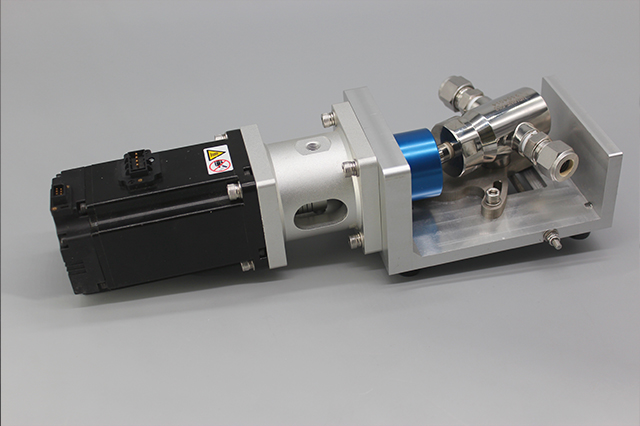
Applying these established technical differences and material benefits to real-world fluid transfer conditions allows procurement and engineering teams to specify the correct pump technology for their facilities. Diaphragm pumps should be specified for general bulk transfer, applications requiring high flow rates, or scenarios where the fluid contains large, irregular solids that do not require exact volumetric dosing. Their ability to run dry and handle variable suction conditions makes them ideal for general utility transfer, wastewater management, and broad chemical movement.
Conversely, valveless ceramic pumps are engineered specifically for precision. They should be specified when the application demands exact, repeatable fluid injection over millions of cycles without volumetric drift. For instance, H&R FLUID offers valveless ceramic metering pumps with injection ranges from 0.008 ml to 50 ml across models HRBWF-F01 to HRBWF-F06. This broad but highly controlled range makes them ideal for micro-dosing in chemical processing, medical diagnostics, and electronics manufacturing. In lithium-ion battery manufacturing, for example, injecting the exact volume of electrolyte is critical for battery performance and safety; a deviation in dosing can lead to defective cells. When evaluating a Micro Ceramic Metering Pump for low-volume applications (such as the 0.008 ml range), the absence of check valves ensures that microscopic air bubbles or particulates do not disrupt the dosing accuracy.
Important limitation: While valveless ceramic metering pumps offer superior precision and longevity, they are not universally applicable. Evaluators must note the following constraints before specification:
They are not universally superior to diaphragm pumps for all fluid types; highly viscous fluids or fluids with massive solid particulates may require alternative configurations, such as a Ceramic Piston Dispensing Pump.
The ±0.5% repeat metering accuracy is typically tested with pure water; actual operational accuracy may vary depending on the specific gravity, temperature, and rheology of the target fluid.
They are designed for precise metering and dosing rather than high-volume, high-pressure bulk fluid transfer.
To determine if a valveless ceramic metering pump aligns with your specific fluid transfer requirements, contact H&R FLUID for a technical scenario assessment. Engineering teams can review your fluid properties, required injection volumes, and lifecycle expectations to confirm the appropriate pump specification for your facility.
Standard piston pumps typically rely on inlet and outlet check valves to control fluid direction during the piston's stroke. A valveless ceramic metering pump eliminates these valves by using a plunger that simultaneously rotates and reciprocates. The rotation aligns a flat section of the plunger with the inlet and outlet ports at the correct times, mechanically controlling flow direction without vulnerable valve components.
Due to the elimination of wear-prone check valves and the use of ultra-hard ceramic components, these pumps offer exceptional longevity. H&R FLUID valveless ceramic pumps can operate continuously and stably for over 60 million cycles, drastically reducing the frequency of maintenance interventions and replacement costs compared to traditional valve-based systems.
The core plungers in these precision pumps are manufactured using 99.7% high-purity alumina/zirconia ceramic material. This specific composition is selected for its extreme hardness, resistance to chemical corrosion, and ability to maintain microscopic dimensional tolerances under continuous friction without galling or degrading.
When tested with pure water as the medium, H&R FLUID valveless ceramic pumps achieve a repeat metering accuracy that is typically better than ±0.5%. This high level of precision is maintained over time because there are no soft seals or valves to degrade and alter the displacement volume, relying instead on a rigid 2-micron fit clearance.
Diaphragm pumps rely on flexible membranes and check valves. In precision metering applications, check valves can stick, wear, or allow slight backflow (slip) if particulates prevent perfect seating. Additionally, the flexible diaphragm can stretch or degrade over time. These mechanical realities make it difficult for standard diaphragm pumps to maintain ultra-precise, repeatable micro-dosing over millions of cycles compared to rigid valveless systems.


