

close
Choose Your Site
Global
Social Media

Views: 0 Author: Site Editor Publish Time: 2026-09-16 Origin: Site


Ceramic plunger pumps utilizing special-grade alumina offer critical advantages for micro-dispensing, specifically achieving ±0.5% accuracy (when tested with pure water) and broad chemical compatibility. By maintaining extreme dimensional stability, these pumps can reliably dispense volumes ranging from 25 µL up to 2700 µL per stroke. For procurement managers and technical evaluators, selecting this technology ensures the consistent, contamination-free fluid transfer required in highly regulated sectors such as battery manufacturing, electronics, and pharmaceuticals.
Key Takeaways:
High-Precision Dispensing: Systems achieve a baseline dispensing accuracy of ±0.5%, enabling strict volumetric control for micro-scale manufacturing processes.
Micro-Volume Capabilities: Specific pump models support injection ranges starting from as low as 25 µL per stroke up to 2700 µL per stroke.
Advanced Material Construction: The core mechanism relies on special-grade alumina ceramic plungers and pump sleeves for exceptional wear resistance and dimensional stability.
Comprehensive Chemical Inertness: The fluid path utilizes a combination of PTFE, FKM, and alumina ceramic wetted materials to safely handle corrosive and high-purity fluids.
The fundamental performance of any micro-dispensing system relies on the physical characteristics of its core displacement components. In high-precision environments, standard metallic or polymer plungers often suffer from microscopic wear, thermal expansion, or chemical degradation over time. When exposed to continuous friction or temperature fluctuations, metals can expand or contract, while polymers may warp or shed particulates. These minute structural changes directly compromise volumetric consistency, leading to unacceptable variance in the dispensed fluid.
To resolve these mechanical vulnerabilities, H&R FLUID engineers its dispensing systems using special-grade alumina ceramic plungers and pump sleeves. Alumina ceramic is characterized by its extreme hardness and structural rigidity. When machined to exacting tolerances, the ceramic plunger and the corresponding pump sleeve create a near-perfect seal without the need for flexible, wear-prone elastomeric O-rings in the primary displacement zone.
This exceptional dimensional stability means the physical geometry of the plunger and sleeve remains constant even after thousands of actuation cycles. Because the components do not warp under pressure or degrade from continuous friction, the internal displacement volume remains strictly fixed. This mechanical reliability is the direct prerequisite for achieving micro-liter precision. Furthermore, the inherent hardness of special-grade alumina minimizes particulate shedding caused by component friction, protecting high-purity fluids from mechanical contamination during the transfer process. For industries where even microscopic particulate contamination can ruin a production batch, this material advantage is a non-negotiable requirement.
The physical stability provided by alumina ceramic translates directly into measurable, repeatable performance metrics. For technical evaluators sizing equipment for production lines, the primary criteria for pump selection are the minimum achievable shot volume and the consistency of that volume over continuous operation.
The Ceramic Plunger Dispensing Pump achieves a dispensing accuracy of ±0.5%. This tight tolerance ensures that highly sensitive manufacturing processes—such as dosing active pharmaceutical ingredients or applying conductive adhesives—receive the exact required volume, minimizing material waste and preventing product defects.
To accommodate different scale requirements within micro-dispensing, the equipment is configured into specific volumetric ranges. The HRZSWL-1.27 series offers distinct models tailored to exact stroke volumes, allowing facilities to scale from delicate R&D applications to higher-volume production runs without changing the underlying technology platform:
HRZSWL-1.27-4/0.7: Designed for the most delicate applications, this model provides an injection range of 25 µL to 700 µL per stroke, featuring a minimum shot volume as low as 25 µL. This is particularly useful for micro-dosing in lab environments, applying minute drops of specialized fluids, or handling highly concentrated reagents where excess volume leads to significant financial loss.
HRZSWL-1.27-8/2.7: Engineered for slightly larger micro-dispensing tasks, this model covers an injection range of 100 µL to 2700 µL per stroke. It bridges the gap between micro-scale precision and continuous production line requirements, offering flexibility for automated assembly processes.
Important limitations regarding precision:
The stated ±0.5% dispensing accuracy is a baseline performance metric tested with pure water.
Actual operational accuracy in a production environment may vary depending on the specific viscosity, temperature, and particulate content of the dispensed fluid.
Establishing this mechanical baseline dictates how the pump will perform under ideal conditions. However, industrial micro-dispensing rarely involves pure water, requiring the system to pair this mechanical precision with robust chemical defenses.
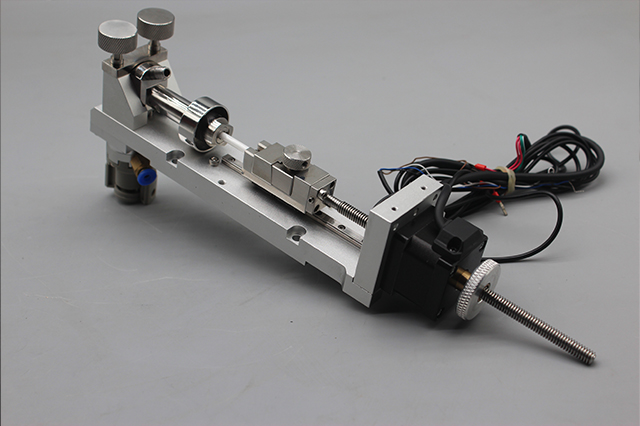
While the alumina ceramic plunger ensures volumetric accuracy, the broader fluid path must withstand the chemical properties of the transferred media. Micro-dispensing applications frequently involve aggressive solvents, corrosive acids, or highly reactive chemical additives that would rapidly degrade standard pump housings and seals.
To ensure the entire system remains chemically inert, the wetted materials in these pumps are strictly limited to PTFE, FKM, and Special-Grade Alumina Ceramic. Each material serves a specific protective function within the fluid architecture. PTFE (Polytetrafluoroethylene) is utilized for its near-universal chemical resistance, forming a highly effective barrier against aggressive solvents, strong acids, and bases. This prevents chemical leaching into high-purity fluids, which is a common failure point in standard pumps.
FKM (Fluoroelastomer) is deployed in secondary sealing areas where both chemical resistance and slight compressibility are required to maintain system integrity under pressure. Unlike primary displacement zones that rely on the rigid ceramic-to-ceramic seal, these secondary areas need FKM's flexibility to absorb minor vibrations and prevent external leaks without compromising the chemical barrier.
Working in conjunction with the special-grade alumina ceramic, these wetted materials create a continuous, non-reactive fluid path. This configuration prevents the pump components from oxidizing, swelling, or dissolving when exposed to harsh media. For procurement teams dealing with unique or highly aggressive proprietary chemicals, evaluating these specific wetted materials is a critical step. When standard configurations require adaptation for highly specialized chemical environments, exploring Customization options for ceramic machining ensures the fluid path meets exact compatibility standards without sacrificing the underlying ±0.5% volumetric accuracy.
The combination of micro-liter precision (25 µL to 2700 µL) and comprehensive chemical inertness dictates the specific scenarios where these pumps are most effectively deployed. Ceramic plunger pumps are purpose-built for sectors where microscopic deviations in fluid volume result in total product failure, making them fundamentally distinct from heavy industrial or high-volume transfer equipment.
In battery manufacturing, the precise injection of highly reactive and corrosive electrolytes into battery cells is a critical quality control checkpoint. The alumina ceramic and PTFE/FKM wetted materials withstand the corrosive nature of the electrolyte, while the ±0.5% accuracy ensures each cell receives the exact chemical volume required for optimal energy density and safety. Over-dispensing can cause dangerous swelling and thermal runaway risks, while under-dispensing severely limits battery lifespan and energy capacity. The ceramic pump's ability to maintain its accuracy over thousands of cycles ensures that every cell off the assembly line meets strict quality control standards.
In electronics assembly, manufacturing processes rely on the micro-dispensing of fluxes, conductive adhesives, and protective coatings onto densely packed circuit boards. The ability to consistently dispense volumes as low as 25 µL allows manufacturers to apply these fluids to microscopic components without overflow, short circuits, or material waste. As electronic components continue to miniaturize, the demand for this level of volumetric control becomes increasingly critical to maintaining high production yields and minimizing costly rework.
For pharmaceuticals and chemicals, the requirement for contamination-free transfer is absolute. The non-shedding nature of special-grade alumina ceramic ensures that high-purity reagents and active pharmaceutical ingredients remain uncontaminated by the pump mechanism itself. The tight volumetric control allows for the exact dosing of chemical additives and the precise filling of vials, ampoules, or diagnostic cartridges, ensuring compliance with strict industry regulations and quality assurance protocols. Evaluators looking to match these capabilities to specific production lines can review the full range of Products to identify the correct volumetric model for their application.
The baseline dispensing accuracy of ±0.5% is established through standardized testing using pure water. When dispensing fluids with significantly higher or lower viscosities, the flow dynamics within the pump chamber change. Highly viscous fluids may require adjustments to the actuation speed, system pressure, or tubing diameter to maintain this level of accuracy, and the actual operational precision must be validated against the specific fluid properties.
While special-grade alumina ceramic provides the mechanical rigidity and wear resistance necessary for the plunger and sleeve, a complete pump system requires static seals and fluid path housings. PTFE and FKM are selected as wetted materials because they offer exceptional chemical resistance that matches the inertness of the ceramic. This prevents corrosive fluids from degrading the secondary components and compromising the overall system seal.
Although special-grade alumina ceramic is highly resistant to wear and corrosion, the pumps are not zero-maintenance devices. Routine maintenance primarily involves thorough flushing and cleaning of the fluid path with appropriate neutralizing solvents or pure water to prevent the buildup of dried chemicals or particulates. If left uncleaned, these residues can interfere with the micro-clearances between the plunger and the sleeve. Regular inspection of the FKM seals is also required to ensure ongoing system integrity.
Shot volumes can be adjusted within the specific mechanical limits of the chosen pump model. For example, the HRZSWL-1.27-4/0.7 model allows for volume adjustments anywhere between 25 µL and 700 µL per stroke, while the HRZSWL-1.27-8/2.7 model can be adjusted between 100 µL and 2700 µL per stroke. This adjustment is typically managed through the mechanical stroke length of the driving mechanism rather than dynamic, on-the-fly software changes during a single stroke.
Contact H&R FLUID to request a scenario assessment and confirm specification fit for your micro-dispensing application. Our technical team can verify chemical compatibility and recommend the precise volumetric configuration required for your production environment.


